Description
A 10pF ceramic capacitor is a passive electronic component used in various electronic circuits for storing and releasing electrical energy.
Characteristics:
Capacitance: The capacitance of this capacitor is 10 picofarads (pF), which is equivalent to 10×10 −12 farads. This is a very small capacitance value, suitable for high-frequency applications.
Type: Being ceramic, it is made from a ceramic dielectric material. Ceramic capacitors are non-polarized, meaning they can be connected in any direction in a circuit.
Voltage Rating: The maximum voltage rating for ceramic capacitors can vary. It’s important to ensure the voltage in your application does not exceed this rating to avoid damage.
Tolerance: Ceramic capacitors have a tolerance value which indicates the range within which the actual capacitance value can vary from the stated value. For example, a 10pF ±5% capacitor can have an actual capacitance between 9.5pF and 10.5pF.
Temperature Coefficient: Ceramic capacitors come with different temperature coefficients (e.g., C0G/NP0, X7R), which describe how the capacitance changes with temperature. C0G/NP0 types have very stable capacitance with temperature changes, while X7R types may have more variation.
Applications:
High-Frequency Circuits: Due to their small capacitance and low inductance, 10pF ceramic capacitors are often used in high-frequency circuits, such as RF (radio frequency) applications and oscillators.
Decoupling and Filtering: They are used for decoupling (smoothing out) signals in digital circuits and filtering out high-frequency noise.
Technical Details
- Capacitor Type: Ceramic capacitor
- Capacitor Value: 10pF
- Package: Through Hole
- Polarity: Non-Polarised
- Linearity: Nearly Linear
- Voltage: 50V
- Pitch: 5mm
- Does not vary much with Temperature
Capacitance meter with Arduino
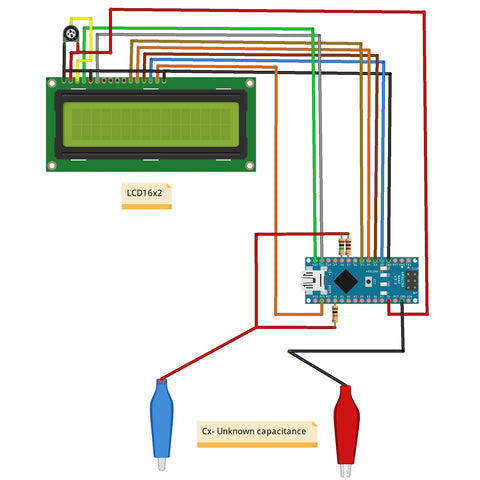
Sample Code
| //www.kitsguru.com |
| #include <LiquidCrystal.h>
|
| LiquidCrystal lcd(12, 11, 5, 4, 3, 2);// RS,E,D4,D5,D6,D7
|
|
void setup(){ |
| lcd.begin(16, 2);// LCD 16X2
|
|
pinMode(A0,INPUT); |
| } |
|
unsigned long time0,time1,time2; |
|
float c,null0; |
| byte kn,mk,i; |
|
|
void loop(){ |
| lcd.setCursor(15,0); |
| lcd.print("*"); |
|
if(mk==0){ |
|
pinMode(8,OUTPUT); |
|
pinMode(7,INPUT); |
|
digitalWrite(8,HIGH); |
| } |
|
|
if(mk==1){ |
|
pinMode(7,OUTPUT); |
|
pinMode(8,INPUT); |
|
digitalWrite(7,HIGH); |
| } |
|
| time0=micros(); |
|
while(analogRead(A0)<644){ |
| time2=micros()-time0; |
|
if(time2>=1000000 && mk==0){ |
| mk=1; |
| time0=100000000; |
|
break; |
| } |
| } |
|
| time1=micros()-time0; |
|
|
while(analogRead(A0)>0){ |
|
pinMode(7,OUTPUT); |
|
pinMode(8,OUTPUT); |
|
digitalWrite(7,LOW); |
|
digitalWrite(8,LOW); |
| } |
|
|
if(mk==1&&time1<1000){ |
| mk=0; |
| } |
|
| lcd.setCursor(1,0); |
| c=time1; |
| c=c/1000-null0; |
| c=abs(c); |
|
|
if(time1>=10000000){ |
| lcd.setCursor(1,0); |
| lcd.print(" TEST uF "); |
| } |
|
else{ |
| lcd.print(c); |
|
|
if(mk==0){ |
| lcd.print(" nF "); |
| } |
|
if(mk==1){ |
| lcd.print(" uF "); |
| } |
| } |
|
if(i==0){ |
| i++; |
| null0=c+0.02; |
| } |
|
delay(100); |
|
}
Ceramic Capacitor & Symbol

Package Includes
- 1 x 10pF Ceramic Capacitor
|


